Monday, 27 May 2019

Helgoland - the Sea Bird Island

Helgoland is a hotspot for bird watching. The island is actually one of the most important breeding areas for a wide variety of sea birds.

On today's walk around the island I was able to get in close contact with hundreds of gannet couples (in Swedish: havssula). They quickly became my favourites because of their size. It is the biggest sea bird in the North Atlantic region.  A gannet can be 87-100 cm long with a wing span of 170-180 cm (67-71 in). Around 400 gannet couples call Helgoland home.

Gannet juveniles are mostly grey-brown, becoming increasingly white in the five years it takes them to reach maturity.
Gannet colonies are mostly located on offshore islands, such as Helgoland, with cliffs from which they can easily launch into the air. Gannets hunts for fish, that forms the bulk of their diet, by making high-speed dives into the sea.


Helgoland - the Crab Fishing Port

Fishing was, in the old days, quite an important food source for the local population of Helgoland. Today fishing plays a limited role in the islands economy. Crab fishing, however, is still going on .Most of the catch is sold to local restaurants here. Helgoland "knieper" (crab claws) is one popular local speciality.

I couldn't find any good illustration for this article, but please except a local artists impression of colourful fantasy fishes.


Helgoland - the Island "Seaty"

You can live your whole life in Helgoland (1.0 sq. km small) without ever leaving this island. Everything you need for your daily life is available here, just like in any small German town on the mainland. Bank, post office, school, hospital, a public library, several shops including a well equipped food market and a big variety of restaurants. There's even a small airport 2 km away on the neighbouring Dune island (0.7 sq. km). The natural connection between the two islands was destroyed during a storm tide in 1720. There's a frequent ferry service connecting the two islands.

Visitors can choose among more than 2,800 guest beds; from four-star hotels to holiday flats and houses to simply furnished private rooms. For a bit of a Robinson feeling you can stay in a tent on the campsite on the Dune.


Sunday, 26 May 2019

Helgoland - Traditional Costumes

The people living on Helgoland and in other parts of Friesland likes to wear their traditional clothes during festivities or whenever possible. Today, by chance, I had a chance to see a demonstration by two Friesland women when they showed their multilayered long skirts. After this little show it was time for a bit of folk dancing. The dancing here reminded me about traditional dancing in Dalarna, Sweden.


Helgoland - the Sunny Island

Helgoland is ranked as one of the sunniest places in Germany. The mild climate, thanks to the Gulf Stream, makes for mild summers and winters here. Even some exotic plants can spend the winter outside here without any worries.

At lunch time today I met a very talkative couple from Lübeck (this is a very German destination - a perfect place to practice my German language skills!). They told me that they had just spent one sunny week here and that today was the first rainy day! They wished me better luck with the weather for a future visit. During their week here they had seen lots of birds and taken long walks around the island.

So much to see and so little time here at Helgoland! We are now planning to set sail tomorrow at 10 AM. Our next destination is Brunsbüttel in Germany.


Helgoland - the Wellness Island

The car-free environment here makes it the ideal destination for health and wellness. A holiday on Helgoland means, not least for allergy sufferers and asthmatics, that by coming here they can breathe deeply again. The island air in the middle of the North Sea is very rich in iodine and oxygen, it is nearly emission-free and poor in pollen.

Helgoland is also an official German spa destination under the name "the North Sea Spa". All traditional spa treatments are available here including medicinal baths and various wellness offers. All island visitors, including those arriving by own vessel like ourselves, are required to pay a small spa fee, even if you don't use any of the spa facilities.

Helgoland is also a shopper's paradise. The island is not subject to the EU Customs Code, meaning that products are exempt from customs duties and  VAT. 

Today I met many daytrippers arriving by a catamaran coming from Hamburg. I have a strong feeling that most of them came here to buy tax free alcohol,  tobacco and parfum rather than to participate in any wellness program. On my rainy village walk today I tried to find shops displaying atmosphere rather than spirits...


Saturday, 25 May 2019

Helgoland landing

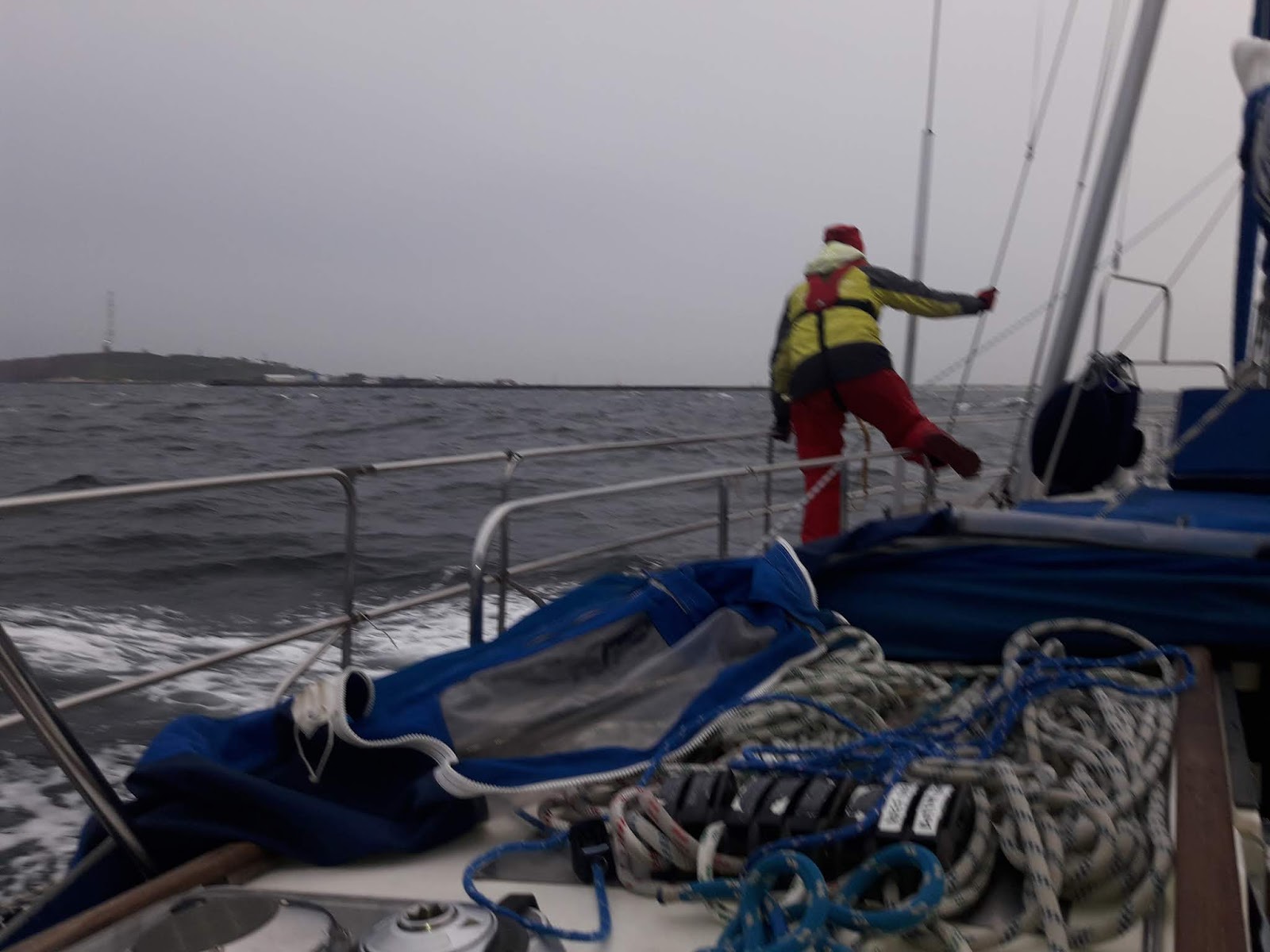
After 18 hours of sailing, covering 89 NM, we have now landed in a rainy and windy Helgoland.  We had good sailing conditions most of the way from Holland. But to cross over two major sea routes in the darkness on the North Sea was exciting. Ships kept popping up from nowhere, both on Jennifer's radar screen and visually for the night crew. Tore and I had the night shift from 1-4 AM, but Ingemar was kind enough to extend his shift and assist us for an additional two hours. He really helped us by keeping a close watch over oncoming traffic and to suggest course alterations for Jennifer in order to keep us all safe and sound.

The small harbour behind the wave breaker at Helgoland is really crowded and we are now double parked and attached to a big yacht. In order to get ashore we have to climb over to the deck of our neighbour.

On the screenshot below, taken at 2.30 AM, you can see Jennifer (the red boat) at the junction of two major sea routes. Helgoland is visible in the upper right corner of the photo.